
Four steps from application to scheduled delivery.
Specification Review
Herd health, genetics, and production practices are reviewed against Kingston Place's standard.
Traceability Onboarding
Animals are identified and enrolled in the record-keeping process that carries through harvest.
Scheduling
Delivery windows are set against regional aggregation volume and processing availability.
Delivery & Settlement
Animals are received against specification, weighed, and settled under the terms agreed at onboarding.
More than a buyer. A development partner.
Selling cattle is one way to work with Kingston Place — not the only way. Producers can keep ownership longer, gain better information on their own cattle, and access managed development and downstream market pathways without building the entire infrastructure themselves.
Direct Supply
Producers sell qualified cattle directly into Kingston Place programs — against a written specification, a delivery schedule, and settlement terms agreed at onboarding.
Stocker & Backgrounding Programs
Producer-owned calves or growing cattle enter a managed development program — weight gain, health management, and documentation that positions them for future allocation.
Retained Ownership / Background-to-Buy
Producers retain ownership while Kingston Place develops and tracks the cattle. Qualifying animals can later transition into Kingston Place programs through a pre-agreed commercial pathway.
Producer-Owned Finish & Conversion
Selected cattle remain producer-owned through a longer development or finishing cycle while Kingston Place coordinates feed, management, traceability, specification compliance, processing pathways, and market routing.
Heifer & Breeding-Stock Development
For operations building or upgrading a herd, Kingston Place supports the development, documentation, and breeding preparation of producer-owned females — with selective placement where program fit exists.
Every pathway runs on the same operating system. Cattle in development build a documented record — health, gain, disposition, and specification fit — that stays with the animal and informs every later decision, whichever ownership path it takes.
MANY ORIGINS.
ONE SPECIFICATION.
ONE SCHEDULE.
Regional supply enters one coordinated delivery plan. The shared specification and schedule make dispersed producer volume usable as a dependable regional stream.
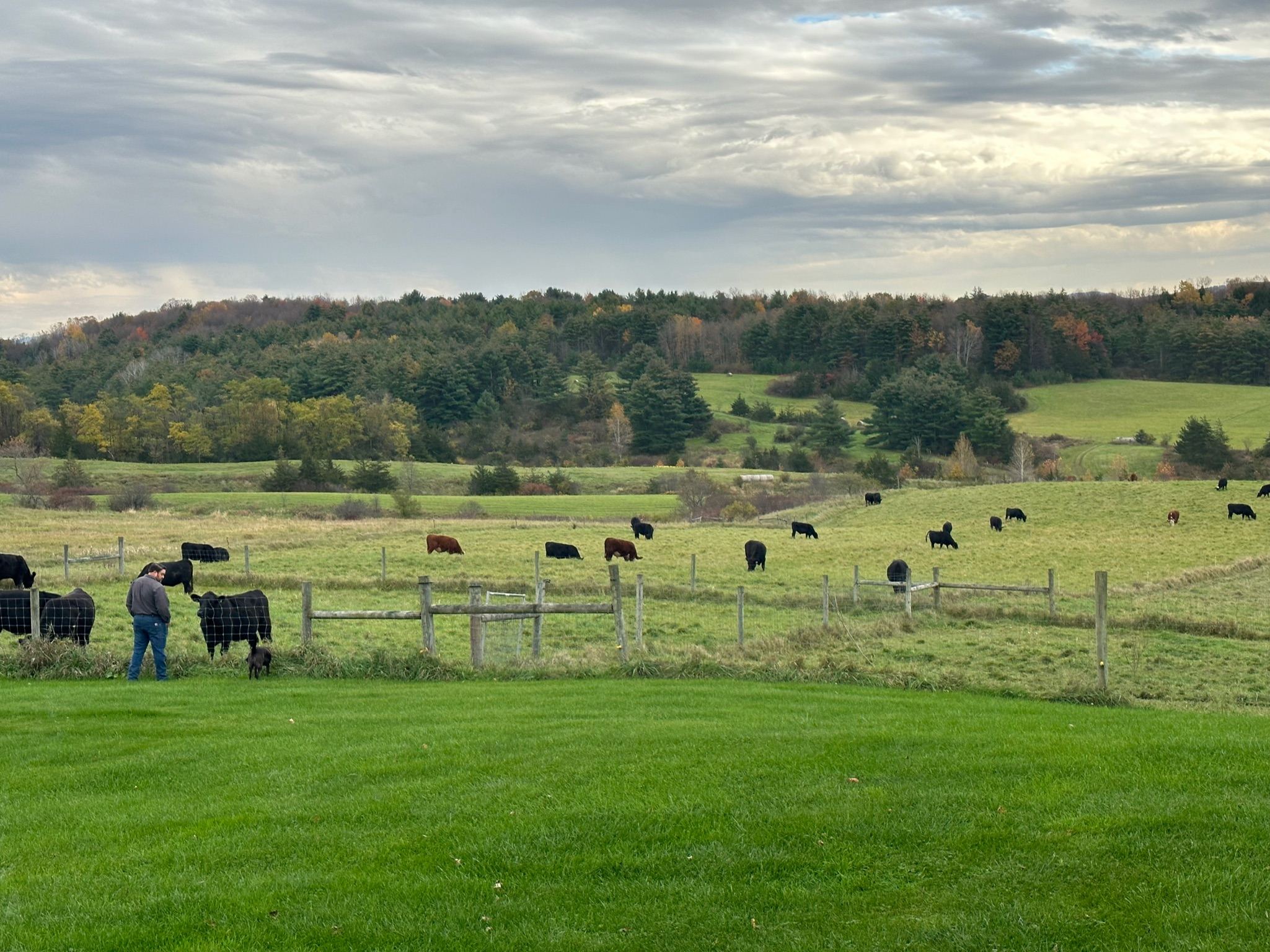
What producer specifications currently cover.
Animal Health & Handling
Herd health records and animal-welfare handling practices consistent with Kingston Place's own operating standard.
Identification & Records
Individual animal identification maintained from the supplying operation through delivery.
Delivery Readiness
Weight, condition, and scheduling windows aligned to aggregation and processing calendars.
Common producer questions.
Straight answers on how the program evaluates cattle and what starting the conversation actually involves.
What cattle does Kingston Place evaluate?
Beef and dairy-beef cattle raised in the Northeast, across classes — from feeder groups through finished loads. Fit depends on class, weight range, timing, and protocol compatibility rather than any single breed requirement, and each inquiry is reviewed against current program needs.
How does qualification begin?
With a short producer inquiry — your operation, herd type, approximate head count, and timing. Kingston Place reviews producer inquiries personally. If there appears to be a fit, our team will follow up within two business days to discuss your cattle and walk through documentation at a high level.
Do I need EID tags or BQA certification already in place?
Existing electronic ID or BQA certification helps, but neither is a prerequisite for starting the conversation. Documentation requirements are addressed as part of qualification, and the program works with producers on what records matter and how they are kept.
What volumes and timing does the program look for?
Scheduled, repeatable supply rather than one-off spot lots. Groups are planned into delivery windows, and consistency matters more than scale — well-documented small and mid-size operations are relevant alongside larger ones.